Building off Electric Flux
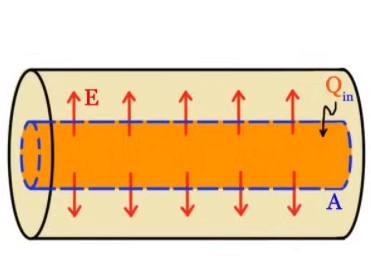
- this states the amount of flux in a Gaussian solid in an electric field
- if the charge is not centered it stil/ is the same as the symmetrical one
 \
\
- Gauss’ law tells us that to find the E field in the enclosed space we integrate along all of the E arrows that pierce through the solid
- if the charge is not centered it stil/ is the same as the symmetrical one
Spherical Symmetry
-
Point Charges
-
Point charge
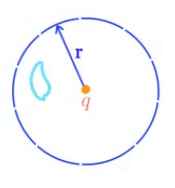
- When we have a sphere with the cross section that looks like the picture above we can assume the sphere the potential is treated as a point charge (we don’t need to get q enclosed because it is a point charge and the charge is given)
-
Point charge in metal shell
-
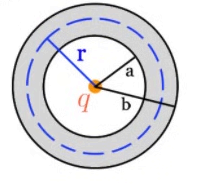
its different from the point charge because we must under these 3 things
-
- this is because when we are outside the shell the metal shell inherits the charge
-
-
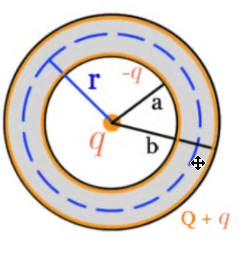
Metal shell with net charge Q, surrounding point charge q
-
- i don’t know why but im guessing it’s because of the charges inside and out fighting each other and it being always q
-
- no matter what inside a metal the field will always be 0
-
- additive
-
-
Metal shell with net charge Q
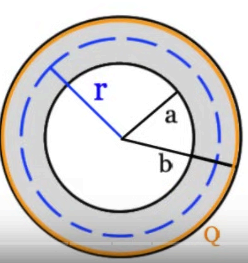
-
- no charge inside
-
- again no charge in metal
-
- easy
-
-
How to find E in the Gauss law
- THIS IS NOT a formula this is just the derivation of it